
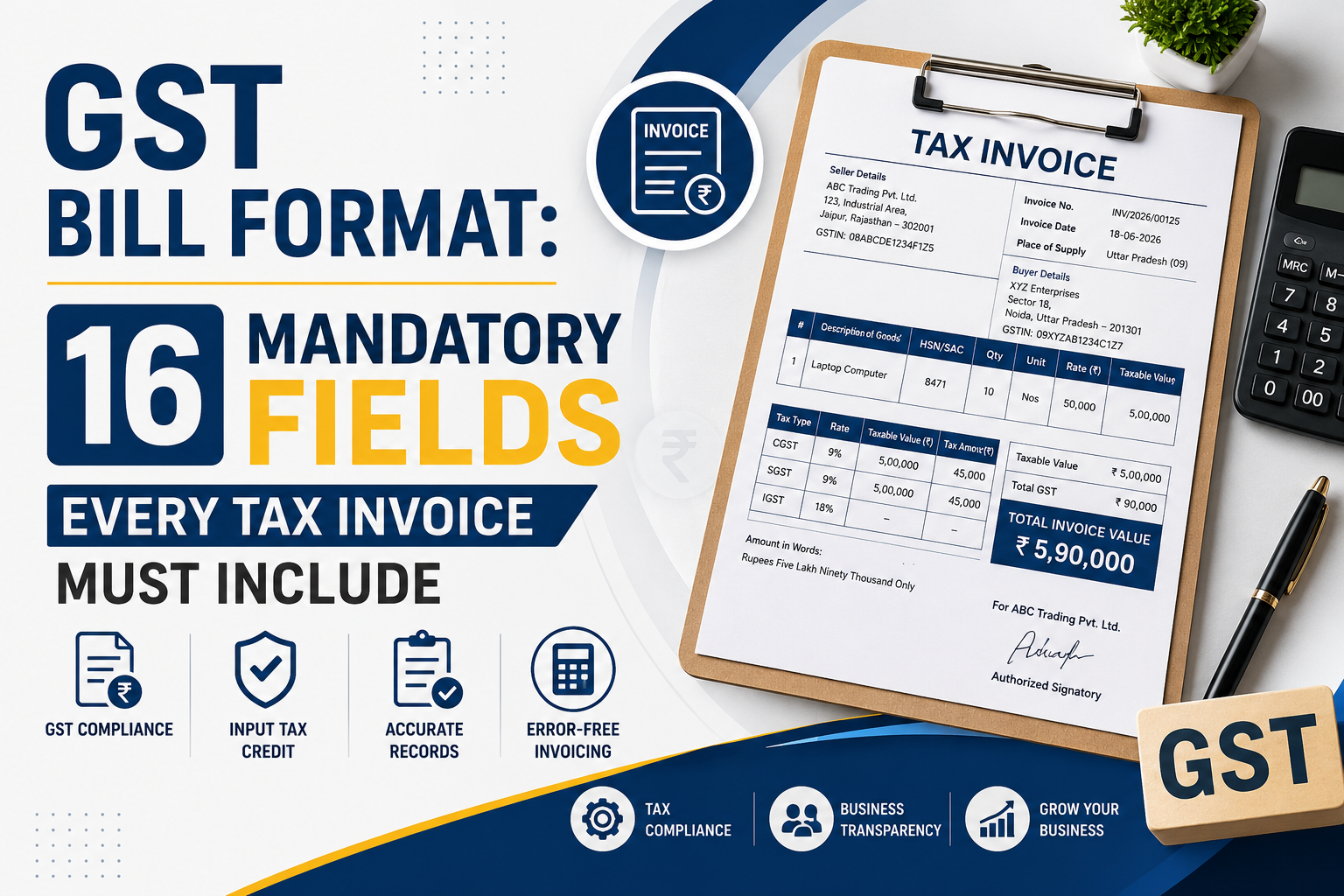
Goods and Services Tax (GST) has transformed the taxation system in India by introducing a unified indirect tax structure. Whether you are a manufacturer, trader, wholesaler, retailer, freelancer, or service provider, issuing a GST-compliant tax invoice is a legal requirement for registered businesses.
A properly structured GST bill not only ensures compliance with GST regulations but also helps customers claim Input Tax Credit (ITC), improves accounting accuracy, and reduces the risk of penalties during tax audits.
In this detailed guide, we explain the GST bill format, its importance, and the 16 mandatory fields every GST tax invoice must include according to GST invoicing provisions in India.
What is a GST Bill?
A GST Bill, commonly referred to as a GST Invoice or Tax Invoice, is an official document issued by a GST-registered supplier to a buyer for the supply of goods or services.
The invoice serves multiple purposes:
- Evidence of supply
- Basis for GST calculation
- Input Tax Credit (ITC) claim document
- Accounting and bookkeeping record
- Legal proof during audits and assessments
Every GST-registered business must issue invoices in the prescribed format to remain compliant with GST laws.
Why is a GST-Compliant Invoice Important?
A GST invoice is more than just a bill. It plays a crucial role in:
1. GST Compliance
Businesses must issue invoices containing all mandatory details prescribed under GST rules.
2. Input Tax Credit (ITC)
Customers can claim GST credit only when invoices contain correct GST information.
3. Tax Audit Readiness
Proper invoices simplify audits and GST return filing.
4. Business Transparency
Invoices create a transparent record of transactions between suppliers and buyers.
5. Legal Protection
Invoices act as legal evidence in disputes related to payments, taxes, and supplies.
Standard GST Bill Format
A typical GST invoice contains:
- Seller Information
- Buyer Information
- Invoice Details
- Product or Service Details
- Tax Details
- Total Payable Amount
- Authorized Signature
16 Mandatory Fields Every GST Invoice Must Include
The following details are mandatory in a GST bill format:
1. Invoice Title
The document must clearly mention:
"Tax Invoice"
For specific cases, it may be labeled:
- Bill of Supply
- Debit Note
- Credit Note
However, for taxable supplies, "Tax Invoice" should be prominently displayed.
Example
TAX INVOICE
2. Invoice Number
Every GST invoice must have a unique serial number.
Requirements
- Maximum 16 characters
- Can contain alphabets
- Can contain numerals
- Can include special characters like hyphen (-) or slash (/)
Example
INV/2026/00125
The invoice number should be unique for each financial year.
3. Invoice Date
The date on which the invoice is issued must be clearly mentioned.
Example
Invoice Date: 18-06-2026
This date determines GST liability and return filing timelines.
4. Supplier Name
The legal name of the business issuing the invoice must be mentioned.
Example
ABC Trading Pvt. Ltd.
The name should match GST registration records.
5. Supplier Address
Complete business address including:
- Building Number
- Street Name
- City
- State
- PIN Code
Example
Plot No. 45, Industrial Area,
Jaipur, Rajasthan – 302001
6. Supplier GSTIN
GST Identification Number (GSTIN) of the supplier is mandatory.
Example
GSTIN: 08ABCDE1234F1Z5
Without GSTIN, the document may not qualify as a valid GST invoice.
7. Customer Name
The recipient's name should be mentioned clearly.
Example
M/s XYZ Enterprises
For B2B transactions, legal business names are preferred.
8. Customer Address
The buyer's complete address should be included.
Example
Sector 18,
Noida, Uttar Pradesh – 201301
This helps determine the place of supply.
9. Recipient GSTIN (For Registered Buyers)
If the buyer is GST-registered, their GSTIN must be included.
Example
GSTIN: 09XYZAB1234C1Z7
This is essential for Input Tax Credit claims.
10. Place of Supply
Mandatory especially for interstate transactions.
Example
Place of Supply: Uttar Pradesh (09)
This determines whether:
- CGST + SGST applies
- IGST applies
11. HSN Code or SAC Code
GST invoices must mention:
HSN Code
For Goods
SAC Code
For Services
Example
HSN: 8471
or
SAC: 998314
These codes classify products and services under GST.
12. Description of Goods or Services
Each item supplied should be described properly.
Example
| Description |
|---|
| Laptop Computer |
| Website Development Service |
| Office Furniture |
The description should clearly identify the product or service.
13. Quantity and Unit
For goods, quantity details are required.
Example
| Quantity | Unit |
|---|---|
| 10 | Nos |
| 25 | Kg |
| 100 | Pieces |
This field may not be applicable for some service invoices.
14. Taxable Value
Taxable value means the amount on which GST is calculated.
Formula
Taxable Value = Quantity × Rate
Example
| Qty | Rate | Taxable Value |
|---|---|---|
| 10 | ?500 | ?5,000 |
Discounts should generally be adjusted before calculating taxable value.
15. GST Rate and GST Amount
Applicable GST rate must be shown separately.
Example
| Tax Type | Rate | Amount |
|---|---|---|
| CGST | 9% | ?450 |
| SGST | 9% | ?450 |
| IGST | 18% | ?900 |
This allows transparent tax computation.
16. Total Invoice Value
The final payable amount including GST should be displayed prominently.
Formula
Total Amount =
Taxable Value + GST Amount
Example
| Particular | Amount |
|---|---|
| Taxable Value | ?5,000 |
| GST | ?900 |
| Total | ?5,900 |
This is the amount payable by the customer.
Additional Details Recommended in GST Invoice Format
Although not always mandatory, businesses commonly include:
Authorized Signatory
For ABC Trading Pvt. Ltd.
Authorized Signatory
Contact Information
- Phone Number
- Email Address
- Website
Payment Terms
- Due Date
- Credit Period
- Bank Details
E-Way Bill Number
Applicable for movement of goods beyond prescribed limits.
QR Code
Increasingly used for digital verification and payment collection.
Sample GST Invoice Format
| Particulars | Details |
|---|---|
| Invoice No. | INV/2026/00125 |
| Invoice Date | 18-06-2026 |
| Supplier Name | ABC Trading Pvt. Ltd. |
| GSTIN | 08ABCDE1234F1Z5 |
| Buyer Name | XYZ Enterprises |
| Buyer GSTIN | 09XYZAB1234C1Z7 |
| Place of Supply | Uttar Pradesh |
| HSN Code | 8471 |
| Product | Laptop |
| Quantity | 10 |
| Rate | ?50,000 |
| Taxable Value | ?5,00,000 |
| GST Rate | 18% |
| GST Amount | ?90,000 |
| Total Invoice Value | ?5,90,000 |
Common GST Invoice Mistakes to Avoid
Many businesses unknowingly make invoicing errors that can lead to compliance issues.
Avoid These Mistakes
- Missing GSTIN
- Duplicate invoice numbers
- Incorrect HSN/SAC codes
- Wrong GST rates
- Incorrect place of supply
- Missing customer GSTIN
- Calculation errors
- Not maintaining invoice sequence
- Mismatch between invoice and GST returns
Benefits of Using an Automated GST Invoice Format
Modern businesses increasingly use Excel templates or billing software because they offer:
- Automatic GST calculations
- Error-free invoicing
- Faster bill generation
- Easy GST return filing
- Professional invoice design
- Better record management
- Reduced compliance risk
Businesses using automated GST invoice formats save significant time and improve accuracy compared to manual billing methods.
GST Bill Format in Excel
Excel remains one of the most popular tools for creating GST invoices because it offers:
- Easy customization
- Formula-based GST calculations
- Automatic totals
- Printable invoice layouts
- Low implementation cost
A well-designed GST bill format in Excel can automatically calculate:
Taxable Value = Qty × Rate

GST Amount = Taxable Value × GST %

Total Amount = Taxable Value + GST Amount
This makes invoice creation simple even for small businesses.
Frequently Asked Questions (FAQs)
Is GSTIN mandatory on every GST invoice?
Yes. A GST-registered supplier must mention their GSTIN on every tax invoice.
Can I create a GST invoice in Excel?
Yes. Excel is widely used for creating GST-compliant invoice formats with automated calculations.
Is customer GSTIN mandatory?
Customer GSTIN is mandatory for registered buyers claiming Input Tax Credit.
What is the difference between HSN and SAC?
- HSN Code is used for goods.
- SAC Code is used for services.
What happens if a GST invoice is incorrect?
Incorrect invoices can lead to ITC rejection, GST return mismatches, notices, penalties, and compliance issues.
A GST-compliant tax invoice is a critical document for every registered business in India. Including all 16 mandatory fields—such as invoice number, date, GSTIN, HSN/SAC code, taxable value, GST amount, and total invoice value—ensures legal compliance, smooth accounting, and seamless Input Tax Credit claims.
Whether you create invoices manually or use a GST bill format in Excel, always verify that every mandatory field is correctly filled. Accurate invoicing not only keeps your business compliant but also builds trust with customers and simplifies GST return filing.