
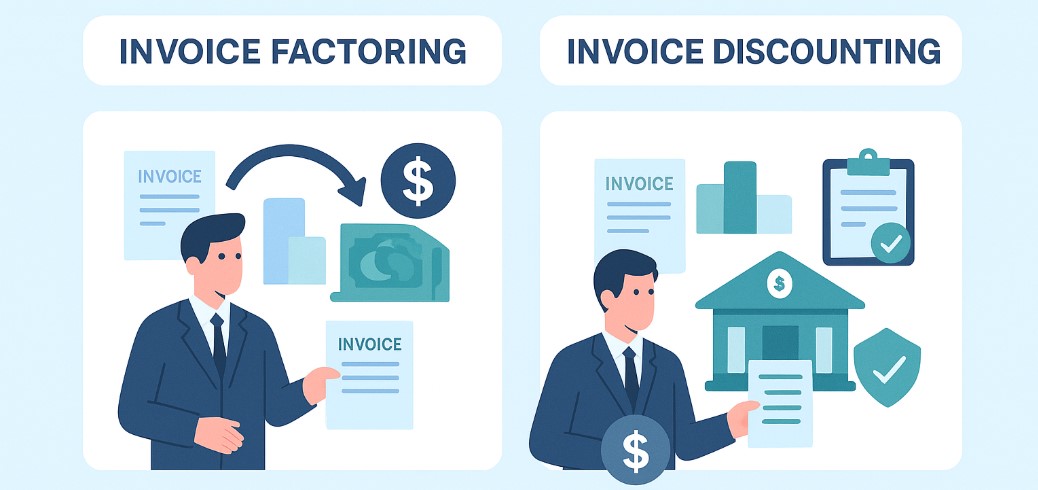
Every business issues invoices with credit periods—30, 60, or even 90 days. But when payments are delayed, companies face cash flow gaps that disturb daily operations, payroll, and inventory purchases. To bridge this working capital shortage, businesses turn to invoice financing solutions, primarily invoice factoring and invoice discounting.
Although both help businesses unlock cash tied up in unpaid invoices, they differ significantly in terms of ownership of receivables, customer interaction, confidentiality, and cost. Understanding the difference helps companies choose the right funding method based on size, financial stability, and operational needs.
What is Invoice Factoring?
Invoice factoring is a financing method where a business sells its unpaid invoices to a financial institution (factor) at a discount. The factor then takes over the responsibility of collecting payments from customers.
Example: A business raises an invoice of ?10,00,000 with a 60-day credit period. The factor buys the invoice and immediately pays 80% (?8,00,000). Once the customer pays the full invoice value to the factor, the remaining amount (minus charges) is released to the business.
In factoring:
- The factor controls the sales ledger.
- The factor directly communicates with customers for payment.
- Best suited for businesses lacking strong credit control teams or needing quick liquidity.
How Invoice Factoring Works (Step-by-Step)
- Business raises an invoice to its customer.
- Invoice is sold to a factor for immediate financing.
- Factor pays 70–90% of the invoice value upfront.
- Factor collects payment from the customer on the due date.
- Factor releases remaining balance after deducting fees and charges.
Types of Invoice Factoring
1. Recourse Factoring
The business is liable if the customer fails to pay. Cheaper due to lower risk for the factor.
2. Non-recourse Factoring
Factor bears credit risk. Useful when dealing with financially unstable customers but has higher fees.
3. Domestic & Export Factoring
- Domestic: Supplier, customer, and factor are in the same country.
- Export: Helps exporters secure payment from overseas buyers.
Advantages of Factoring
- Immediate working capital without waiting for customer payment.
- Outsourced collections, reducing administrative burden.
- Lower credit risk when using non-recourse factoring.
- Suitable for SMEs with weak credit control systems.
Disadvantages of Factoring
- Customers become aware of the financing arrangement.
- Higher cost due to service + interest fees.
- Reduced control over customer communication and relationships.
- May affect brand perception for large or premium clients.
What is Invoice Discounting?
Invoice discounting is a credit facility where businesses use unpaid invoices as collateral to get a short-term loan from banks or lenders. Unlike factoring, the business retains full control of its sales ledger and continues collecting payments from customers.
This process remains completely confidential—customers do not know that the invoices have been pledged.
How Invoice Discounting Works (Step-by-Step)
- Business raises an invoice and submits it to the lender.
- Lender provides an advance (usually 70–85%) against the invoice.
- Customer pays the business directly on the due date.
- Business repays the lender, and the credit line is restored for future use.
Types of Invoice Discounting
1. Recourse Discounting
Business bears the risk of customer default.
2. Confidential Discounting
A silent facility where the customer is unaware of the financing arrangement.
3. Whole Turnover Discounting
Entire receivables book is used to create a revolving credit limit.
Advantages of Invoice Discounting
- Full control over sales ledger and customer relationships.
- Completely confidential, maintaining brand image.
- Cheaper than factoring due to lower administrative involvement.
- Ideal for businesses with strong finance & collection teams.
Disadvantages of Invoice Discounting
- Strict eligibility—usually available to established businesses.
- Credit risk remains with the business.
- Requires strong financial statements, good credit score, and stable customer base.
Below is well-structured, detailed, SEO-ready content for all the remaining sections.
Key Differences Between Invoice Factoring vs Invoice Discounting
| Criteria | Invoice Factoring | Invoice Discounting |
|---|---|---|
| Ownership of Receivables | Sold to the factor; factor becomes legal owner of the receivables. | Receivables remain with the business; only used as collateral. |
| Control on Sales Ledger | Managed by the factor, including tracking, follow-ups, and reconciliation. | Fully controlled by the business; internal finance team handles all receivables. |
| Customer Communication | Factor directly communicates and collects from customers. | No third-party involvement; customers pay the business directly. |
| Cost | Generally higher due to both discount charges and service fees. | Lower cost because only interest or discount charges apply. |
| Risk | Can transfer risk to factor in non-recourse arrangements. | Risk always stays with the business; lender only provides finance. |
| Confidentiality | Not confidential; customers know payments go to the factor. | Highly confidential; customers are unaware of the arrangement. |
| Eligibility | Suitable even for businesses with weaker credit control or inconsistent cash flow. | Requires strong credit history, robust sales ledger, and reliable customer payments. |
| Business Size Suitability | Ideal for startups, SMEs, and companies without strong collections teams. | Preferred by mid-sized and large enterprises with stable operations. |
Which is Better for Your Business?
Choosing between invoice factoring and discounting depends on business size, financial strength, risk appetite, and operational needs. Below is a practical decision guide:
Small or Emerging Businesses with Weak Credit History → Choose Factoring
- Quick access to cash with minimal eligibility criteria.
- Collections handled by factor, reducing internal workload.
- Lower reliance on internal finance departments.
Established Companies With Strong Receivables → Choose Discounting
- Prefer confidentiality and full control over customer relationships.
- Lower financing costs compared to factoring.
- Reliable internal teams can manage receivables efficiently.
When Business Faces Urgent Cash Flow Needs
- Factoring is faster, as funds are released immediately upon invoice sale.
- Useful when a company cannot wait until customers pay.
When Confidentiality is Important
- Invoice Discounting ensures customers remain unaware of financing arrangements.
- Helpful for brands that want to maintain a premium or stable market perception.
When Outsourcing Collections is Preferred
- Factoring is ideal since the factor completely takes over collection activities.
- Suitable for companies dealing with large customer bases or slow-paying clients.
In short:
- Choose factoring when you need fast funds + support in collections.
- Choose discounting when you want cheaper finance + confidentiality.
Factoring vs Discounting
Understanding the cost structure helps businesses calculate the true expense of each financing method.
Fee Structure Explanation
Invoice Factoring Costs
- Discount Rate / Interest Rate
Charged on the advanced amount until the customer pays. - Service Fee / Administration Fee
Covers ledger management, follow-ups, credit checks, and collections. - Additional Charges
- Minimum usage fee
- Setup fee
- Documentation charges
- Renewal charges
Invoice Discounting Costs
- Discount Rate / Interest Rate
Charged similar to a business loan against the invoice value. - Monitoring / Audit Fees
For periodic review of receivables. - Additional Charges
- Processing fee
- Annual facility fee
- Limit enhancement charges
Hidden Costs to Check
- Charges for late customer payments
- Overdue interest
- Minimum commitment fee
- Early termination fee
- Credit insurance in non-recourse arrangements
Example Cost Calculation
Invoice Value: Rs 10,00,000
Advance: 80% (Rs 8,00,000)
Credit Period: 60 days
Example 1: Factoring
- Discount Rate: 2% per 30 days → 4% for 60 days
- Service Fee: 1% on total invoice value
Total Cost = Discount Charges + Service Fee
= (4% of Rs 8,00,000) + (1% of Rs 10,00,000)
= Rs 32,000 + Rs 10,000
= Rs 42,000
Net Cash Received After Settlement:
= Rs 10,00,000 – Rs 42,000 = Rs 9,58,000
Example 2: Invoice Discounting
- Discount Rate: 1.5% per 30 days → 3% for 60 days
- Processing Fee: Rs 5,000
Total Cost = Discount Charges + Processing Fee
= (3% of Rs 8,00,000) + Rs 5,000
= Rs 24,000 + Rs 5,000
= Rs 29,000
Net Cash Received After Settlement:
= Rs 10,00,000 – Rs 29,000 = Rs 9,71,000
Discounting is cheaper but requires stronger financial credibility.
Risk Factors: What to Evaluate Before Choosing
Before opting for invoice factoring or discounting, businesses should evaluate the following risks:
Customer Creditworthiness
- The entire model relies on whether buyers can pay on time.
- For customers with weak payment history → choose non-recourse factoring for protection.
Consistency of Invoice Volume
- Irregular sales may increase service cost under factoring.
- Banks may reduce discounting limits if invoice volume fluctuates.
Industry Type
Certain industries have higher default risks, such as:
- Construction
- Transport
- Retail distributors
Lenders may charge higher rates or restrict eligibility.
Contract Terms
Read the fine print on:
- Minimum lock-in period
- Minimum invoice value per month
- Early exit penalty
- Overdue interest rates
Recourse vs Non-Recourse Implications
Recourse
- Business bears full payment risk.
- Cheaper but risky if customers delay or default.
Non-Recourse
- Factor absorbs the risk of non-payment.
- Higher cost but safer for businesses dealing with risky buyers.
Market Demand & Trends in Invoice Financing
Invoice financing—once a niche funding tool—has now become a mainstream working capital solution globally. Businesses across manufacturing, trading, services, logistics, and exports increasingly rely on factoring and discounting to maintain liquidity and stabilize operations.
Growing MSME Adoption
In India, MSMEs often struggle with delayed payments from large buyers. With extended credit cycles becoming the norm (60–120 days), invoice financing has emerged as a lifeline by offering:
- Quick access to working capital
- No collateral requirement
- Financing based on customer creditworthiness
- Faster approvals through digital evaluation
The adoption among micro and small businesses has grown rapidly due to increased awareness and the rise of fintech alternatives to traditional bank loans.
Rise of Digital Invoice Financing Platforms
Advanced fintech platforms now use:
- AI-based credit scoring
- Automated invoice verification
- Real-time GST data analysis
- Digital KYC
- API-based bank validations
These capabilities have shortened approval times from days to a few hours, improving accessibility for MSMEs and startups.
Digital platforms also allow:
- Online submission of invoices
- Real-time tracking of payouts
- Transparent pricing
- Instant settlement
- Improved fraud detection
Government Initiatives Like TReDS
The Indian government introduced TReDS (Trade Receivables Discounting System) to help MSMEs receive faster payments from large corporate buyers and PSUs. Platforms such as:
- Vyapaarkhata
- RXIL
- M1xchange
- Invoicemart
enable MSMEs to auction invoices to multiple financiers at competitive rates.
Key benefits of TReDS:
- 100% digital transaction flow
- Transparent pricing
- Lower cost of funds due to competitive bidding
- Guaranteed payment from buyers (reducing risk)
Market Size & Projected Growth
India
The Indian invoice financing market is expanding rapidly, driven by MSME credit gaps. Key trends:
- Current market size estimated at USD 6–8 billion (formal segment).
- Potential market size (including informal receivables) is USD 250+ billion.
- Projected CAGR: 15–20% over the next 5 years.
- Regulatory support from RBI and digitalization is accelerating adoption.
Global
- Global factoring market size: USD 3.5–3.8 trillion.
- Europe holds the largest share, followed by Asia-Pacific.
- Projected CAGR: 10–12%.
- Cross-border/export factoring is growing due to global trade expansion.
- Digital platforms and alternative lenders are reshaping the market.
Top Invoice Factoring & Discounting Companies in India
Below is a curated list of leading banks, NBFCs, and fintech platforms offering reliable invoice financing solutions in India.
Major Banks Offering Invoice Financing
1. ICICI Bank
Offers invoice discounting and supply chain finance for SMEs and corporates with competitive rates and digital onboarding.
2. HDFC Bank
Provides receivable financing based on buyer credit profile with flexible drawdown and repayment options.
3. Axis Bank
Specializes in domestic and export factoring with risk mitigation solutions.
4. Kotak Mahindra Bank
Offers structured invoice discounting for corporates, anchor-based supply chain programs, and MSME funding.
5. SBI (State Bank of India)
Provides invoice discounting through bank branches and also operates on TReDS platforms.
Top NBFCs Offering Factoring/Discounting
1. Tata Capital
Provides working capital loans and invoice discounting with flexible repayment cycles.
2. Aditya Birla Finance
Strong portfolio in receivables financing, suited for mid-sized and large businesses.
3. Bajaj Finance
Offers MSME invoice discounting with quick approvals and minimal documentation.
4. Hero Fincorp
Ideal for small and medium businesses needing short-term receivable funding.
Fintech Platforms & TReDS Operators
1. RXIL (Receivables Exchange of India Ltd.)
India’s first licensed TReDS platform enabling MSMEs to discount invoices from corporate and PSU buyers.
2. M1xchange
A leading online TReDS marketplace connecting MSMEs, corporate buyers, and financiers.
3. Invoicemart (A.TReDS)
Backed by Axis Bank and BSE; provides transparent invoice auctioning and fast settlement.
4. KredX
India’s largest private invoice discounting marketplace offering quick payouts to SMEs and startups.
5. CashFlo
A tech-driven supply chain finance platform that helps businesses unlock working capital instantly.
6. Vayana Network
Provides end-to-end trade finance solutions across domestic and cross-border supply chains.
Documentation Required
Invoice financing requires basic business and financial documents for verification, credit assessment, and compliance.
KYC Documents
- PAN of business/entity
- Aadhaar & PAN of promoters
- Certificate of Incorporation
- Address proof of business premises
- Partnership deed / MoA & AoA for companies
Financial Statements
- Last 1–2 years’ audited financial statements
- Provisional financials (if required)
- Previous year ITR filings
GST Returns
- GSTR-1 and GSTR-3B for the last 6–12 months
- GST reconciliation reports, if demanded
GST data helps lenders verify invoice authenticity and buyer-seller relationships.
Invoice Copies
- Clear, valid invoices raised on customers
- Purchase orders or work orders (if applicable)
- Delivery challans, e-way bills & proof of service delivery
Bank Statements
- Last 6–12 months’ current account statements
- Statements showing payment history of major customers
These help lenders analyze cash flow patterns and transaction consistency.
Common Mistakes to Avoid
Many businesses choose the wrong type of invoice financing or incur unexpected costs. Avoid these mistakes:
Not Checking Hidden Charges
Some lenders impose:
- Minimum usage fee
- Early closure fee
- Additional audit charges
- Overdue interest
Always check the full cost structure before signing.
Poor Customer Credit Analysis
Your customer’s creditworthiness determines:
- Approval of invoices
- Funding limit
- Risk coverage
- Pricing
Businesses often assume lenders take care of this—leading to defaults.
Selecting Incorrect Tenure or Facility Type
- Short credit cycles may not need factoring.
- Long credit cycles with slow-paying customers require risk protection.
- Exporters may need export factoring instead of domestic facilities.
Choose facility type based on actual business cash flow.
Misunderstanding Recourse Liability
Many MSMEs do not understand that in recourse factoring or discounting, the business must repay if the customer does not pay.
This can create unexpected liabilities and cash flow challenges.
Invoice factoring and invoice discounting both help businesses unlock capital tied up in receivables, but their suitability varies based on business size, financial health, and customer profile.
Factoring is ideal when:
- You want quick cash
- You lack a dedicated collections team
- You deal with slow-paying customers
- You are a small or growing business needing operational support
Discounting is ideal when:
- You want confidentiality
- You have a strong credit record
- You want cheaper financing
- You have a disciplined receivables management system
Final Recommendation
- Small & growing MSMEs → Invoice Factoring (easy approval + outsourced collections)
- Established businesses with stable cash inflow → Invoice Discounting (lower cost + confidentiality)
Choosing the right option helps businesses maintain healthy cash flow, reduce operational stress, and improve long-term financial stability.